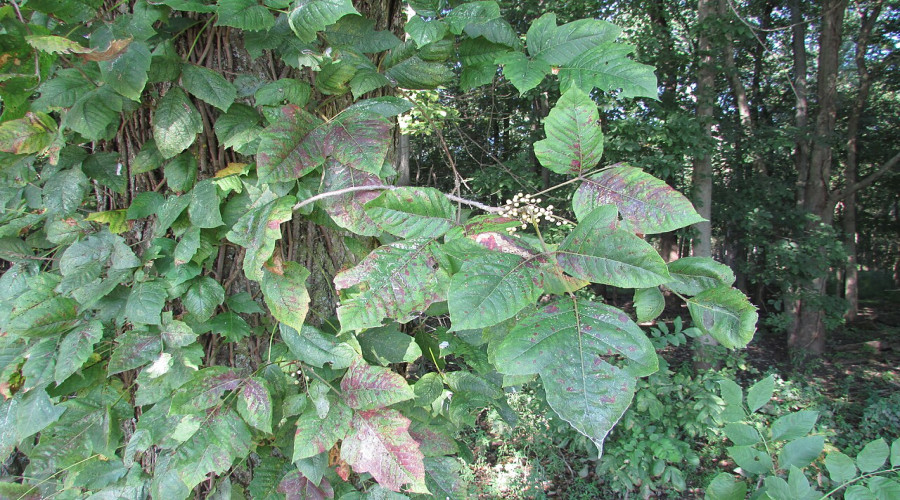
Rhus toxicodendron, often shortened to Rhus tox, is one of the most frequently cited remedies in homeopathic literature. It is made from poison ivy (a Toxicodendron plant), whose oily resin is a well-known cause of itchy skin rashes. In homeopathy it is prepared by serial dilution, which is quite different from touching the living plant.
Source and preparation
Homeopathic remedies are made by diluting a starting substance in repeated steps and shaking it at each stage, a process homeopaths call potentisation. The US National Center for Complementary and Integrative Health (NCCIH) notes that many homeopathic products are so diluted that no molecules of the original substance may remain.
Poison ivy itself is not harmless. Mayo Clinic explains that poison ivy rash is an allergic reaction to an oily resin called urushiol, found in the leaves, stems and roots of poison ivy, poison oak and poison sumac. Redness, itching, swelling and blisters usually appear 12 to 48 hours after contact and can last two to three weeks. Anyone who touches the plant should wash their skin with soap and water as soon as possible, ideally within 30 minutes, Mayo Clinic advises.
Traditional uses in homeopathic literature
William Boericke's Homoeopathic Materia Medica, a classic reference published in the early 20th century, describes Rhus tox as acting strongly on fibrous tissue such as joints, tendons and their sheaths, producing pain and stiffness. A characteristic detail in the text is that movement "limbers up" the person, who feels better for a time after changing position, together with marked restlessness. Boericke lists traditional uses for ailments from strains and overlifting, for getting wet while sweating, for rheumatism in the cold season and for stiffness of the back and neck.
On the skin, the text lists red, swollen, intensely itchy eruptions with small blisters, as well as hives. The traditional symptom pattern is also defined by what makes it better or worse. Boericke says it is worse during rest, at night, and in cold, wet weather, and better with warm, dry weather, movement, rubbing and warm applications.
The same entry also lists severe conditions, such as infections, cellulitis and fevers. Those are serious medical problems that need a doctor and should never be managed with a homeopathic remedy alone. These are traditional listings drawn from homeopathic texts, not proven medical effects.
What scientific reviews say
Major reviews have not found reliable evidence that homeopathy works better than placebo. In 2015, Australia's National Health and Medical Research Council (NHMRC) concluded after a broad assessment that there are no health conditions for which there is reliable evidence that homeopathy is effective. NCCIH states that there is little evidence to support homeopathy as an effective treatment for any specific health condition.
Safety and sensible use
For a sprain or strain, the NHS recommends following PRICE therapy for the first two to three days: protection, rest, ice, compression and elevation. It also advises avoiding heat, alcohol and massage in the first couple of days, and gently moving the area once movement is possible without pain. A pharmacist can recommend suitable pain relief. The NHS says to get urgent help if the injury is very painful or getting worse, you cannot put weight on it, the swelling is large or increasing, or you have a high temperature, and to go to A&E if you heard a crack, the limb has changed shape, or the area is numb, tingling or looks blue or grey.
For a rash that may be from poison ivy, Mayo Clinic advises seeing a doctor if it is severe or widespread, affects the eyes, mouth or genitals, keeps swelling, oozes pus, comes with a fever, or does not improve within a few weeks. No homeopathic product should delay proper care or replace medicines prescribed by a doctor.
This article is for general information only. Consult a registered physician before taking any medicine.
Sources: Boericke, Homoeopathic Materia Medica (Rhus toxicodendron); NCCIH, Homeopathy: What You Need To Know; NHMRC Statement on Homeopathy (2015); Mayo Clinic, Poison ivy rash; NHS, Sprains and strains.
Image: Poison ivy (Toxicodendron radicans), the plant from which Rhus tox is made. Photo: Chris Light via Wikimedia Commons, CC BY-SA 4.0 (https://creativecommons.org/licenses/by-sa/4.0). Source: https://commons.wikimedia.org/wiki/File:Poison_Ivy_(Toxicodendron_radicans)_7027.jpg