With 19 days left before the Ganges Water Sharing Treaty expires on 12 December, Bangladesh and India are holding routine technical meetings, but New Delhi has not said when formal negotiations on a new agreement might begin.
On Sunday, 22 November, the two countries held the 91st meeting of the Joint Committee of the Joint Rivers Commission (JRC) in Dhaka. According to the Daily Star, UNB and The Business Standard, the meeting finalised the annual report on the treaty's implementation for 2026. It did not discuss renewal. "This wasn't a meeting on a new treaty. It was a regular meeting of the Joint Rivers Commission," Md Anwar Kadir, who led the six-member Bangladesh delegation, told The Business Standard. The Indian side was led by Sharad Chandra, a commissioner in India's Ministry of Jal Shakti.
Bangladesh says it has done its part. It formed a high-level technical committee in June and asked India to name its own team, repeating the request in August. Water Resources Minister Shahiduddin Chowdhury Anee also wrote to his Indian counterpart on 17 November, urging an early start to talks, The Business Standard reported. Prof Rashed Al Mahmud Titumir, who heads the committee, told UNB that Bangladesh had completed all necessary preparations and hoped India would take the required steps before the treaty's term ends.
India has not named a negotiating team. When the Daily Star asked the Indian High Commission in Dhaka for its position, it shared a September clip in which Indian Foreign Ministry spokesperson Randhir Jaiswal said that matters concerning the Ganges and other shared rivers would be discussed through the JRC. Indian media, citing a parliamentary committee report, say India set up an inter-ministerial committee in July 2023 to review the treaty, with representatives of West Bengal and Bihar.
The treaty was signed on 12 December 1996 and runs for 30 years. Under Article XII it can be renewed by mutual consent, and it has no provision for automatic extension. It sets a formula for sharing water at Farakka during the January-May dry season; under annexure I, each country is guaranteed 35,000 cusecs during alternating sets of three 10-day periods between 11 March and 10 May. Minister Anee has said Bangladesh's priority is to restore a guarantee clause like the one in the 1977 agreement, which the 1996 treaty does not contain.
The Business Standard noted that expiry would not necessarily mean India stops releasing water, since the two countries could still agree a new treaty or an interim arrangement. But without an agreement, it said, the legal guarantees behind the current formula could become uncertain. The Daily Star reported that the uncertainty has implications for agriculture, fisheries, navigation and freshwater supply, especially in the south-west, where lower dry-season flows can worsen salinity. Titumir said the Ganges-dependent region covers roughly one-third of Bangladesh and is home to more than five crore people.
Source: The Daily Star, The Business Standard, UNB, The Tribune (India)
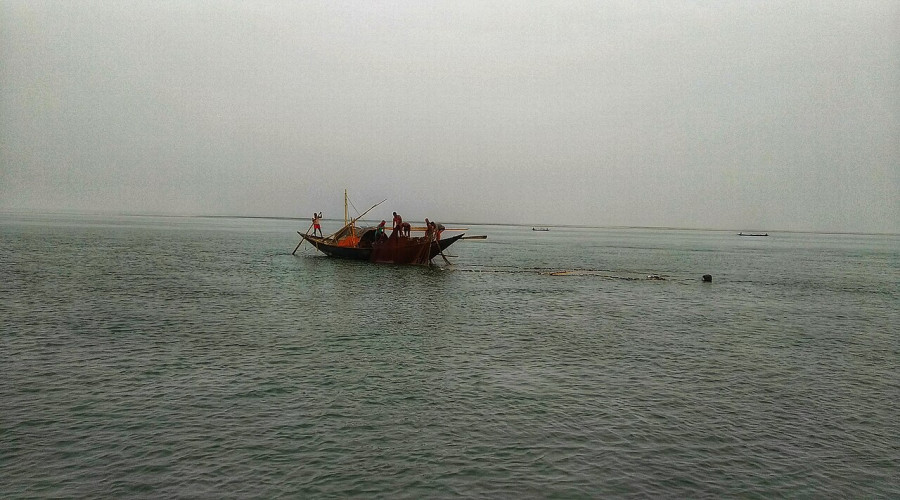
Image: File photo: the Padma River in Bangladesh, the main distributary of the Ganges. Photo: Siem Sifat khan via Wikimedia Commons, CC BY-SA 4.0 (https://creativecommons.org/licenses/by-sa/4.0). Source: https://commons.wikimedia.org/wiki/File:Padma_river_bangladesh.jpg