The European Space Agency's Euclid space telescope has discovered the most distant quasar known, a bright galactic core seen as it was just 630 million years after the Big Bang. The discovery was announced by ESA on Tuesday (24 November), when the study was published in the journal Astronomy & Astrophysics.
A quasar is the extremely bright centre of a galaxy, powered by gas falling into a supermassive black hole. As the gas falls in, it releases huge amounts of energy, and for a time the galaxy's core can outshine all the rest of its stars. Quasars are thought to be a short phase in a galaxy's life.
The new object, formally named J1504+6252, has been nicknamed Dún Aonghasa after a prehistoric cliff-top fort on Inis Mór, an island at the Atlantic edge of Ireland. Astronomers picked it out from millions of objects in about 18 months of Euclid data. Follow-up observations by the W.M. Keck Observatory, the Large Binocular Telescope Observatory, the Hubble Space Telescope and the James Webb Space Telescope confirmed what it is. Webb measurements showed that the central black hole has a mass of roughly 360 million times that of the Sun.
Dún Aonghasa is the first quasar found beyond a redshift of 8. Redshift measures how much light has been stretched by the expansion of the Universe, and this one's is 8.13. That means we are seeing the Universe as it was about 13.1 billion years ago, when it was only around 5 percent of its current age. The find beats Euclid's own record, announced only a few months earlier, by about 40 million years.
The discovery also poses a puzzle. Unlike other very distant quasars, Dún Aonghasa is taking in material relatively slowly. To have become so massive so early, its black hole must have gone through periods of extremely rapid growth very soon after the Big Bang. ESA says this puts pressure on current models of how the first black holes formed and grew.
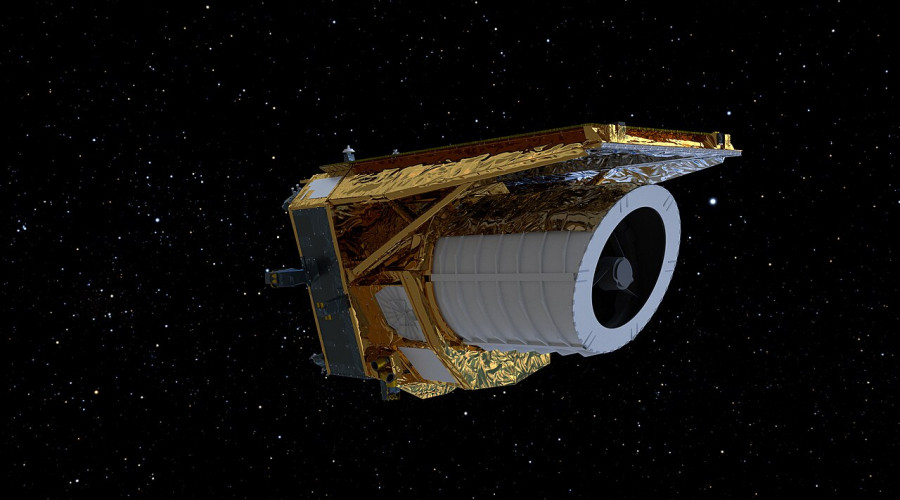
Euclid launched in 2023 to study the "dark Universe", including dark matter and dark energy. It combines sensitive infrared imaging with very wide sky coverage, which makes it well suited to finding rare, distant objects. In about a year and a half, Euclid has announced 31 ancient quasars, 12 of them beyond redshift 7. That is more than double the number previously known at such distances. ESA says quasars at redshift 8 are so rare that at most a few tens are expected in Euclid's entire survey.
Source: European Space Agency (ESA); Astronomy & Astrophysics (Wolf et al., 2026)
Image: Artist's impression of ESA's Euclid spacecraft. Photo: European Space Agency via Wikimedia Commons, CC BY-SA 3.0 igo (https://creativecommons.org/licenses/by-sa/3.0/igo/deed.en). Source: https://commons.wikimedia.org/wiki/File:Euclid_spacecraft_ESA24912474.jpg