Landmines and other explosive remnants of war killed or injured 6,929 people around the world in 2025, the highest number in five years, according to Landmine Monitor 2026. The report was published on Tuesday (24 November) by the International Campaign to Ban Landmines.
Civilians made up about 84 percent of the casualties, and half of them were children, Al Jazeera reported.
Myanmar recorded the highest toll of any country for the third year in a row, with 1,891 casualties. On average, about five people a day were killed or injured by mines there, the report found. Both the military and armed groups have used landmines in the country's civil war. "Myanmar has gone beyond crisis to catastrophe," said Yeshua Moser-Puangsuwan, a co-author of the report. He added that some level of contamination now exists in almost two-thirds of the country's townships. Myanmar and its neighbours in Southeast Asia, including Cambodia, Laos and Vietnam, accounted for 27 percent of the global toll, despite having only 8 percent of the world's population.
Syria came second, with 1,602 casualties in 2025, more than 50 percent higher than the year before. The report links the rise mainly to refugees and displaced people going back to homes and farmland after the fall of Bashar al-Assad in December 2024. "When you look at population movement, a couple of months later you see an increase of incidents in these areas," Katrin Atkins, research lead at Landmine Monitor, told the BBC.
Figures from the UN Mine Action Service (Unmas) show the scale of the problem in Syria. Since Assad's fall, it has recorded at least 1,556 incidents involving explosive ordnance, which have killed 935 people and injured 1,766. Children account for 995 of those victims. Experts told the BBC the real numbers could be 25 to 50 percent higher because of under-reporting.
The campaign is urging more countries to join the 1997 Mine Ban Treaty, which bans the use, stockpiling, production and transfer of anti-personnel mines. Lebanon, the Marshall Islands and Tonga joined during the reporting period, bringing the number of states bound by the treaty to 162. Five countries bordering Russia, namely Finland, Estonia, Latvia, Lithuania and Poland, withdrew, citing the security situation in their region. Ukraine told the United Nations it was suspending implementation of the treaty, a step the treaty does not allow. Landmine Monitor found that Russia, which is not a party to the treaty, has made widespread use of mines in Ukraine, and that Ukraine has also used them.
Source: Al Jazeera, BBC News
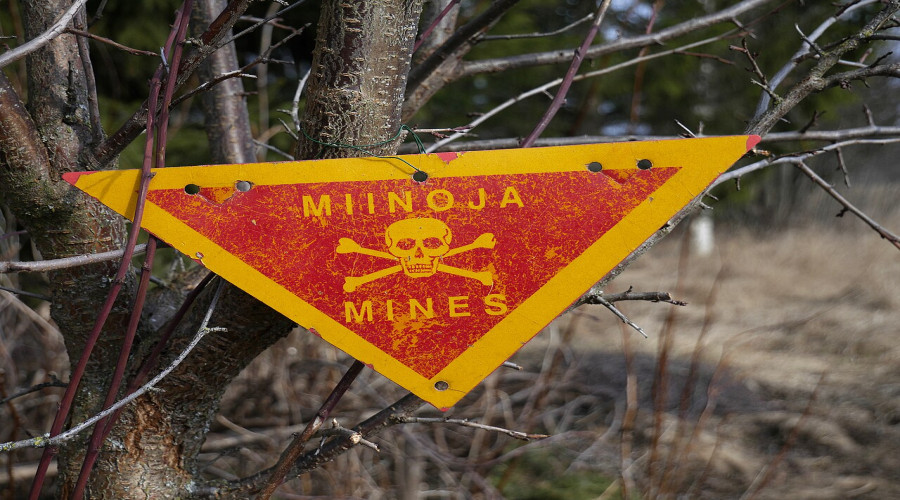
Image: Illustrative photo: a landmine warning sign. Photo: Santeri Viinamäki via Wikimedia Commons, CC BY-SA 4.0 (https://creativecommons.org/licenses/by-sa/4.0). Source: https://commons.wikimedia.org/wiki/File:Landmine_warning_sign_20190408.jpg