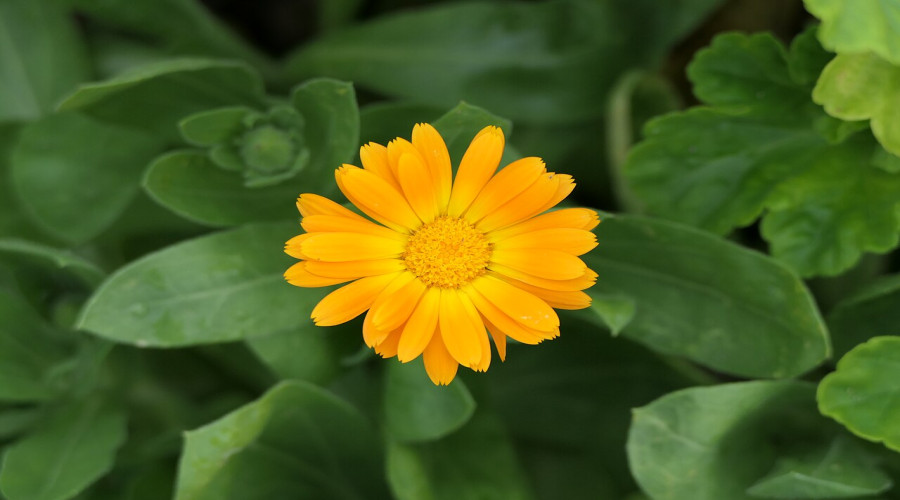
lendulaCalendula officinalis, commonly called pot marigold, is a bright orange or yellow flowering plant in the daisy family (Asteraceae). It should not be confused with the African and French marigolds (Tagetes species), the genda phul widely grown in Bangladesh for garlands, which belong to a different genus. Calendula is one of the best-known remedies in homeopathic practice, where it is used mainly on the skin.
Source and preparation
Homeopathic Calendula is prepared from the flowering plant. A mother tincture is first made from the plant material in alcohol. For remedies taken by mouth, this tincture is then diluted in repeated steps and shaken vigorously at each stage, a process homeopaths call potentisation. Many such preparations are so diluted that, as the US National Center for Complementary and Integrative Health (NCCIH) notes of homeopathic products generally, no molecules of the original substance may remain. Calendula is also widely sold in less-diluted forms for external use, such as creams, ointments and lotions.
Traditional uses in homeopathic literature
In William Boericke's Homoeopathic Materia Medica, a classical reference first published in the early 20th century, Calendula is described as a healing agent "applied locally". It is traditionally used in homeopathy for open wounds, slow-healing sores, minor cuts and grazes, and superficial burns and scalds, with the materia medica noting a picture in which pain seems out of proportion to the injury. Boericke also lists it after tooth extraction and recommends external preparations for abrasions and fissures. These are traditional listings drawn from homeopathic texts, not proven medical effects.
What scientific reviews say
Major scientific reviews have not found reliable evidence that homeopathy works better than placebo. In 2015, Australia's National Health and Medical Research Council (NHMRC) concluded after a broad assessment that there are no health conditions for which there is reliable evidence that homeopathy is effective. NCCIH states that there is little evidence to support homeopathy as an effective treatment for any specific health condition. The UK's NHS notes that complementary therapies, including homeopathy, are not tested in the same way as standard medicines. It is worth noting that some studies of herbal, non-homeopathic calendula creams for skin problems exist, but Memorial Sloan Kettering Cancer Center says larger studies are needed to confirm such findings.
Safety and sensible use
Calendula can cause allergic reactions, and Memorial Sloan Kettering advises against using it if you are allergic to plants in the daisy family. Basic first aid comes first for any cut: stop the bleeding, clean the wound with clean water and cover it with a sterile dressing, the NHS advises. Seek medical help urgently if a wound will not stop bleeding, is large or deep, contains dirt or an object, or was caused by an animal or human bite, or if it becomes red, swollen, increasingly painful or produces pus, or you develop a fever. A tetanus vaccination may also be needed. No homeopathic product should delay proper wound care or replace medicines prescribed by a doctor.
This article is for general information only. Consult a registered physician before taking any medicine.
Sources: Boericke, Homoeopathic Materia Medica (Calendula officinalis); NCCIH, Homeopathy: What You Need To Know; NHMRC Information Paper and Statement on Homeopathy (2015); NHS, Herbal medicines and complementary therapies; NHS, Cuts and grazes; Memorial Sloan Kettering Cancer Center, About Herbs: Calendula.
Calendula officinalis (pot marigold) in flower. Photo: Petro Stelte via Wikimedia Commons, CC BY-SA 4.0 (https://creativecommons.org/licenses/by-sa/4.0). Source: https://commons.wikimedia.org/wiki/File:Calendula-officinalis-Sitia-Crete-Greece.jpg