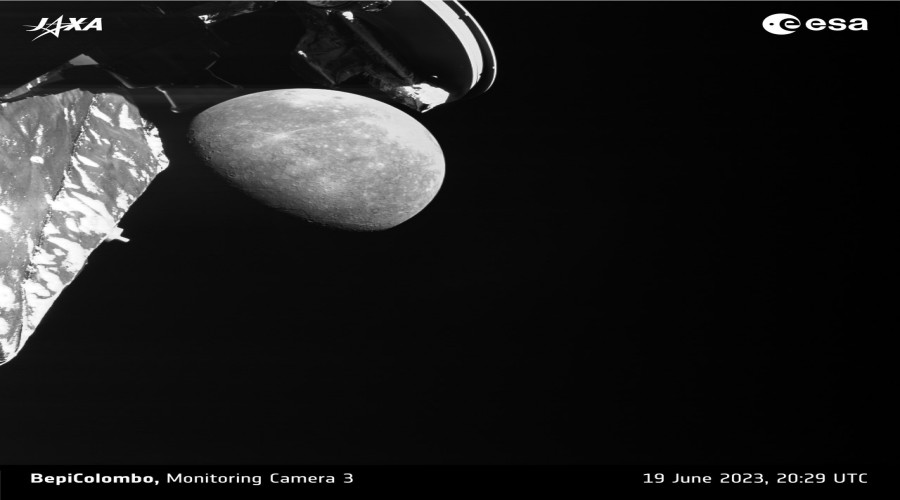
The joint European and Japanese BepiColombo mission has entered orbit around Mercury, the European Space Agency (ESA) announced on Saturday, 21 November, completing a journey of about eight years from Earth. It is only the second spacecraft mission to orbit the innermost planet of the Solar System, after NASA's MESSENGER, which operated there from 2011 to 2015, according to the journal Nature.
BepiColombo is led by ESA in close collaboration with the Japan Aerospace Exploration Agency (JAXA). It carries two science orbiters stacked together: ESA's Mercury Planetary Orbiter (MPO) and JAXA's Mercury Magnetospheric Orbiter, known as Mio, which is sheltered inside a sunshield during the cruise.
According to ESA, four of the MPO's thrusters were used to slow the spacecraft as it approached Mercury's south pole, so that the planet's gravity could capture it. The stack arrived on Mercury's night side and was planned to enter an initial elliptical orbit of about 590 by 11,640 kilometres.
The orbit insertion is one of several steps in the mission's arrival phase. The spacecraft's propulsion module, the Mercury Transfer Module, separated from the two orbiters on 3 September, leaving the MPO in charge of the final approach. ESA said all MPO instruments were switched on together for the first time in mid-September and early checks showed them to be in good health.
The two orbiters are due to separate from each other on 9-10 December, after which BepiColombo will become the first mission to fly two spacecraft around Mercury at the same time. Mio will study the planet's magnetic field and how it interacts with the solar wind from an elliptical orbit, Nature reported, while the MPO will perform a series of further engine burns to lower itself to its final science orbit by March 2027. Science operations for both spacecraft are scheduled to begin in April 2027.
Reaching Mercury is unusually difficult. Emma Bunce, a plasma physicist at the University of Leicester and one of the mission's leading scientists, told Nature that it takes more energy to travel to Mercury than to the outer Solar System. BepiColombo was launched in October 2018 and had to work its way gradually closer to the Sun without gaining so much speed that it overshot Mercury, Nature noted.
During the journey, scientists tested several instruments. Among them was the Mercury Imaging X-ray Spectrometer, which Bunce said is the first X-ray imaging device sent on an interplanetary mission. It was pointed at the Crab Nebula, the remains of a supernova seen from Earth in 1054.
Source: ESA, Nature
Image taken by BepiColombo during a 2023 Mercury flyby (ESA/BepiColombo/MTM). Photo: ESA/BepiColombo/MTM via Wikimedia Commons, CC BY-SA 3.0 igo (https://creativecommons.org/licenses/by-sa/3.0/igo/deed.en). Source: https://commons.wikimedia.org/wiki/File:BepiColombo_hugs_Mercury_ESA24939504.png