Excessive bleeding after childbirth and oxygen deprivation around the time of birth remain the leading causes of maternal and newborn deaths in Bangladesh, according to a government review of deaths recorded in 2025, details of which were reported by The Daily Star on Sunday, 22 November.
The National Maternal and Perinatal Death Surveillance and Response (MPDSR) Progress and Highlights 2025 was published by the Directorate General of Health Services (DGHS) in June. The Centre for Injury Prevention and Research, Bangladesh (CIPRB) prepared it with backing from UNFPA, UNICEF and WHO, drawing on nationwide records from the District Health Information Software-2 (DHIS-2) system.
In 2025, the system recorded 1,252 deaths of mothers and 5,403 deaths of newborns, though under-reporting means the true numbers may be higher. Investigators then studied 315 of the maternal deaths and 547 of the newborn deaths, from 11 districts, in depth.
Postpartum haemorrhage, or heavy bleeding after delivery, accounted for about 44 percent of the maternal deaths analysed, up from 34 percent of the 265 deaths reviewed in 2020. Eclampsia and pre-eclampsia, conditions linked to high blood pressure in pregnancy, together accounted for about a fifth. About two-thirds of the women died in the six weeks after giving birth, and 19 percent died during delivery. Some 42 percent of those who died had delivered at home, traditional birth attendants had assisted in about 45 percent of the births, about 35 percent of the women received no postnatal care, and at least 18 percent died on the way to a health facility.
Among newborns, birth asphyxia caused 43 percent of the deaths analysed, compared with 36 percent in 2020, while problems linked to premature birth accounted for 28 percent. The review noted that warning signs were often present: about 39 percent of the babies had feeding difficulties and 34 percent had fast breathing.
Prof Ferdousi Begum, who previously led the Obstetrical and Gynaecological Society of Bangladesh, told the newspaper that measuring blood loss during delivery, ensuring essential medicines and adopting a WHO-recommended rapid-response approach to bleeding were crucial, along with functional blood banks and proper referral systems. Prof Mohammad Abdul Mannan of Bangladesh Medical University stressed more antenatal check-ups and deliveries attended by trained health workers.
Prof Prabath Chandra Biswas, director general of the DGHS, told the newspaper that strengthening antenatal and postnatal care was central to government plans, including recruiting around one lakh health workers, most of them women, to visit households regularly. Bangladesh aims to cut its maternal mortality ratio, 136 per 100,000 live births in 2023, to below 70 by 2030.
Source: The Daily Star (citing the DGHS MPDSR Progress and Highlights 2025 review)
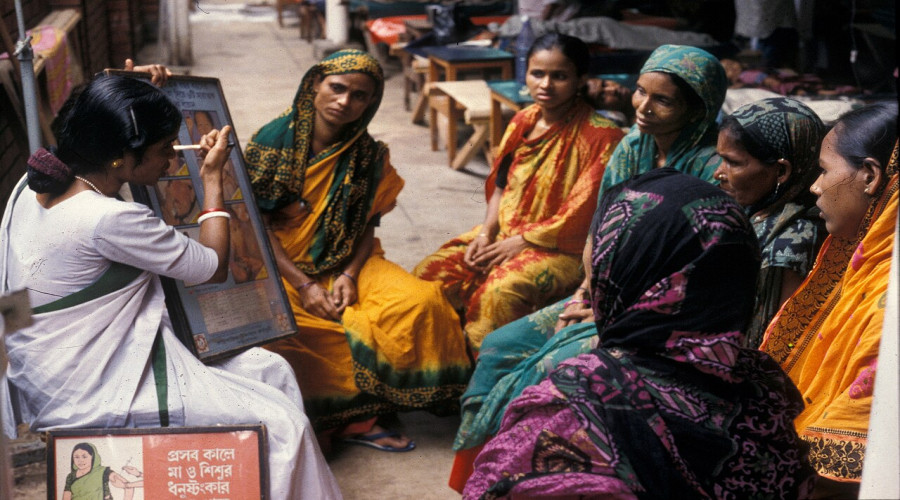
File photo (2006): maternal and child health training in Bangladesh. Photo: Department of Foreign Affairs and Trade via Wikimedia Commons, CC BY 2.0 (https://creativecommons.org/licenses/by/2.0). Source: https://commons.wikimedia.org/wiki/File:Maternal_and_child_health_training._Bangladesh_2006._Photo-_AusAID_(10703397314).jpg