Bangladesh's ready-made garment industry has a new minimum wage, but the argument over who should bear the cost is not settled. After weeks of protests, a government-appointed wage board set the lowest monthly rate at Tk 17,000, a 36 percent increase on the Tk 12,500 fixed in late 2023. Workers had been demanding Tk 30,000. In a Dhaka Tribune analysis, Dr Md Sohel Rana, an associate professor at IUBAT Business School, argues that an industry which can clothe the world but cannot adequately support the people who sew those clothes is not a sustainable model.

The six-member board was formed on 1 November and completed its work on 25 November. The lowest grade rises by Tk 4,500 to Tk 17,000, with higher grades set at Tk 19,200, Tk 20,000 and Tk 21,500, according to The Business Standard and Dhaka Tribune. The increase is expected to take effect in December. Reuters and The Business Standard both described the 36 percent rise as the smallest in about four decades.

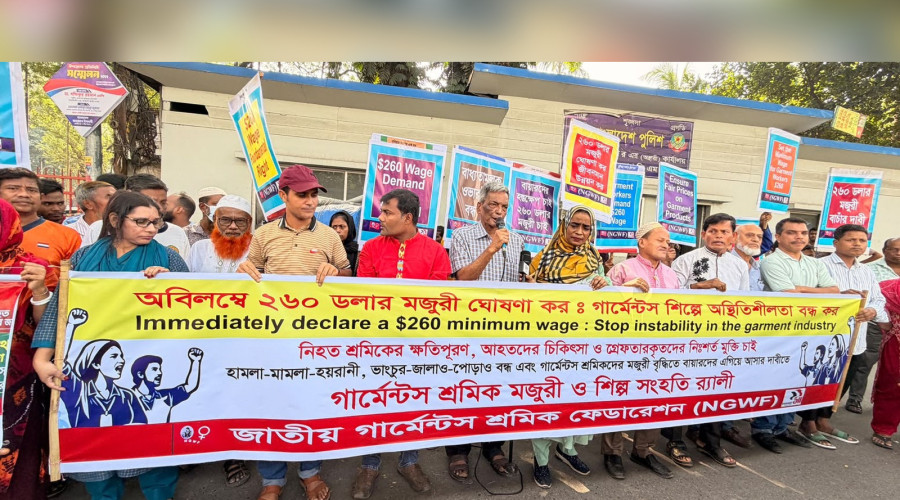
The unrest has already been costly. Demonstrations spread through Gazipur, Savar, Ashulia, Narayanganj and parts of Dhaka as workers sought pay that could keep up with living costs. At the peak on 1 November, the Bangladesh Garment Manufacturers and Exporters Association said operations were disrupted at 529 factories and that 987,190 workers left their workplaces.

The previous increase, from Tk 8,000 to Tk 12,500, took effect on 1 December 2023. Much of that gain has since been eaten away by prices. Official figures from the Bangladesh Bureau of Statistics, also published by Bangladesh Bank, show point-to-point inflation at 8.27 percent in October 2026. Food inflation eased, but non-food inflation rose to 9.89 percent, a 41-month high. Wage growth that month was 7.63 percent, below the inflation rate.

A Clean Clothes Campaign survey of 1,094 garment workers, carried out between May and August 2026, found that 89 percent could not cover their families' basic expenses. Seventy percent had borrowed from friends or relatives, 25 percent had taken out loans, and 28 percent had worked extra overtime to cope.

Factory owners warn that a steep wage rise could squeeze margins and put jobs at risk. Rana writes that this is only half the picture. Labour typically accounts for about 10 to 13 percent of industry costs, according to estimates reported by Reuters, and he argues that job losses are not inevitable if firms can adjust. Prolonged unrest, he notes, also brings closures, delayed shipments and lost orders, which ultimately hurt workers too.

The sharper point in his analysis is the role of global brands. Buyers, he says, demand higher standards on safety, the environment and traceability, yet remain tough on price. A previous International Labour Organization study found limited evidence that buyers were willing to raise the prices they pay Bangladeshi suppliers to cover minimum-wage increases. Without that, Rana argues, the cost is pushed onto factories and, in the end, onto workers. He calls on the industry associations and the government to press brands to absorb the labour-cost share of the new wage.

The garment sector employs about four million people, most of them women, and accounted for 80.62 percent of merchandise export earnings in the 2025-26 fiscal year, or about $38.7 billion, according to Export Promotion Bureau figures compiled by the BGMEA. Bangladesh remains the world's second-largest apparel exporter. Graduation from least-developed-country status is now scheduled for 2029. Private-sector credit growth has been running at around 4 percent, near a multi-decade low.

Rana sets out four steps that, in his view, would help break the cycle: a wage decision based on transparent evidence of costs, inflation, productivity and industry capacity, delivered on a short and binding timetable; annual inflation adjustments between the full revisions now required every three years; support for smaller factories so the new wage is actually paid; and stronger industrial relations, including independent unions and an end to blacklisting or retaliation against workers who protest.

His conclusion is that cheap labour has been a fading advantage, and was never a solid foundation. Future competitiveness, he writes, must rest on productivity, skills, technology and higher-value products, and on wages that can sustain the workers who have made the export boom possible.

Image: Members of the National Garments Workers Federation rally in Bangladesh in November 2026, demanding a higher minimum wage. Photo: Clean Clothes Campaign via Wikimedia Commons, CC BY 4.0 (cropped and reframed; https://creativecommons.org/licenses/by/4.0). Source: https://commons.wikimedia.org/wiki/File:2026_Bangladesh_Garment_Workers_Protest_2.jpg