Astronomers using NASA's James Webb Space Telescope have found evidence that the star which produced the famous supernova remnant Cassiopeia A (Cas A) went through a dramatic internal change, possibly only hours before it exploded. NASA and the European Space Agency released the findings on Monday (23 November). The study was published the same day in The Astrophysical Journal Letters.
Supernova remnants are clouds of gas and dust left behind after a massive star explodes. Over time, this material can seed new generations of stars and planets. As a large star ages, it fuses ever heavier elements in its core and in a series of surrounding shells. NASA says these layers act as a record of the star's history. When the star explodes, the elements are scattered into space, and some condense into dust grains.
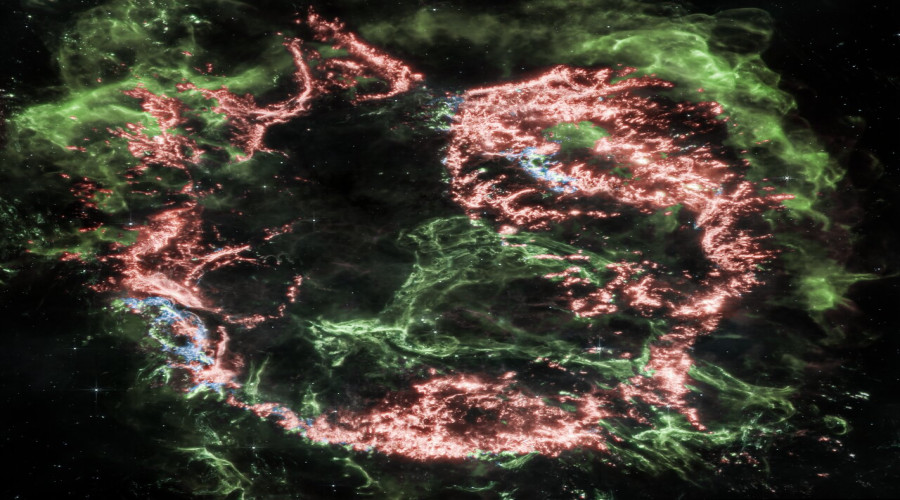
Using Webb's Mid-Infrared Instrument (MIRI), the team mapped dust in individual clumps of the remnant, each roughly the size of a solar system. Data from NASA's retired Spitzer Space Telescope helped them choose three target regions. Two lay in the "reverse-shocked" region, where an inward-moving shock wave collides with debris thrown out by the blast. One of these was rich in silica dust and the other was dominated by carbon dust. The third target, a structure called the "Green Monster" first identified by Webb, was rich in complex magnesium silicates. Unlike the other two, it formed from material the star shed before it exploded.
Together, the dust compositions point to a "shell merger", in which inner layers of the star mix before the explosion. "Material within these shells churns and circulates, which can cause the shells to merge shortly before the supernova explosion," said lead author Tea Temim, a research scientist at Columbia University. Such a merger would change the star's structure and the mix of elements later seen in its debris, she said.
The Webb results build on X-ray observations by NASA's Chandra X-ray Observatory and the Japanese-led XRISM mission. Together, NASA said, the observations indicate that the merger was under way very shortly before the explosion. The Webb dust map also shows merger signatures across much of the remnant.
"It's telling us about what was happening, we think, in the hours leading up to core collapse," said co-author Dan Milisavljevic of Purdue University. He said understanding this process is essential to explaining which elements a supernova releases into the galaxy.
NASA said the work offers astronomers a new way to work out the structure of a star from the dust it leaves behind. Webb is an international programme led by NASA with ESA and the Canadian Space Agency.
Source: NASA, ESA/Webb, The Astrophysical Journal Letters
Image: Webb's mid-infrared (MIRI) image of the supernova remnant Cassiopeia A. Photo: NASA, ESA, CSA, T. Temim (Columbia University), R. Arendt (UMBC), D. Milisavljevic (Purdue University). Image Processing: J. DePasquale (STScI) via ESA/Webb, CC BY 4.0 (https://creativecommons.org/licenses/by/4.0/). Source: https://esawebb.org/images/weic2624a/