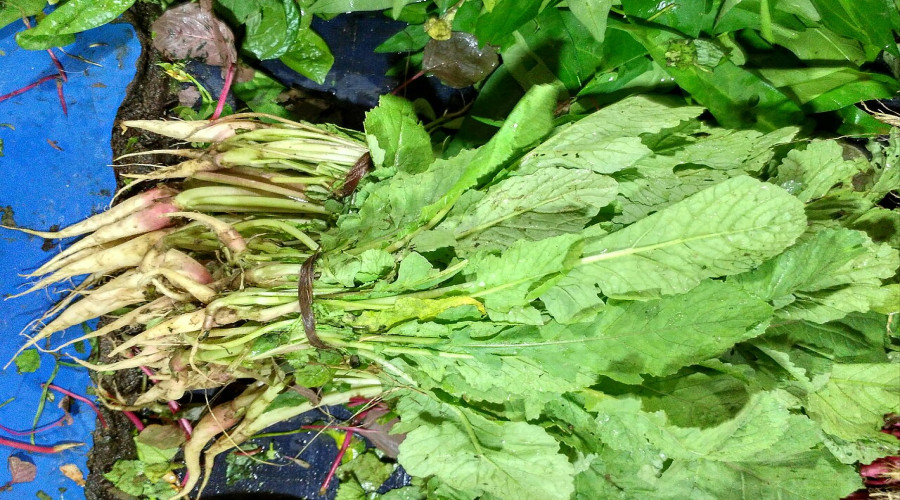
Radish, known in Bangladesh as mula, is one of the most familiar winter vegetables in the country's markets. From late autumn, long white radishes are piled up at village haats and city kitchen markets, often sold with their leafy tops, which are cooked separately as mula shak. Radish is eaten raw in salads and bhorta, cooked in curries and fish dishes, and used as a filling for parathas.
Key nutrients per 100 g
According to the US Department of Agriculture's FoodData Central (SR Legacy entry "Radishes, oriental, raw", FDC ID 168451), which covers the long white type common in South Asia, 100 g of raw radish contains:
Energy: 18 kcal
Water: 94.62 g
Protein: 0.6 g
Total fat: 0.1 g
Carbohydrate: 4.1 g
Dietary fibre: 1.6 g
Total sugars: 2.5 g
Vitamin C: 22 mg
Folate: 28 µg
Vitamin B6: 0.046 mg
Potassium: 227 mg
Calcium: 27 mg
Magnesium: 16 mg
Phosphorus: 23 mg
Iron: 0.4 mg
Copper: 0.115 mg
Sodium: 21 mg
What the evidence says
Radish is mostly water and very low in energy, so it adds volume, crunch and flavour to meals for very few calories. Its most notable nutrient is vitamin C. The US National Institutes of Health (NIH) Office of Dietary Supplements says vitamin C acts as an antioxidant that helps protect cells from damage by free radicals. The body also needs it to make collagen, a protein required for wound healing, and it improves the absorption of iron from plant foods and helps the immune system work properly.
The NIH recommends 90 mg of vitamin C a day for adult men and 75 mg for adult women, with an extra 35 mg for smokers. A 100 g serving of raw radish, at 22 mg, therefore provides roughly a quarter to nearly a third of an adult's daily need, according to our calculation from the USDA and NIH figures. The NIH notes that vitamin C content can fall with long storage and cooking, and that steaming or microwaving may reduce cooking losses. Eating some radish raw, as in salads, helps keep more of it.
Radish belongs to the cabbage family, along with cauliflower, cabbage and mustard. Harvard T.H. Chan School of Public Health's Nutrition Source says a diet rich in vegetables and fruits can lower blood pressure and reduce the risk of heart disease and stroke. It also says the fibre in vegetables and fruits can help relieve or prevent constipation. The World Health Organization (WHO) recommends eating at least 400 g, or five portions, of fruit and vegetables a day to reduce the risk of noncommunicable diseases and to ensure enough dietary fibre.
No single vegetable prevents or cures disease. The benefits come from eating a variety of vegetables regularly as part of a balanced diet.
Ways to eat it
Grate raw radish into salads or raita with a squeeze of lemon. Mash lightly boiled radish with mustard oil, onion and green chilli for bhorta. Add it to fish curries, lentils or mixed vegetable dishes, or use it to stuff parathas. Do not throw away the leaves: mula shak can be stir-fried like other leafy greens.
Cautions
Wash radishes and their leaves thoroughly in clean water, especially if eating them raw. People on a potassium-restricted diet because of kidney disease should follow the advice of their doctor or dietitian on vegetable portions.
For general information only; this is not medical advice.
Sources: USDA FoodData Central (Radishes, oriental, raw, FDC 168451); NIH Office of Dietary Supplements, Vitamin C fact sheet; Harvard T.H. Chan School of Public Health, The Nutrition Source: Vegetables and Fruits; WHO, Healthy diet fact sheet.
Image: Radishes on sale at a kitchen market in Dhaka. Photo: Salim Khandoker via Wikimedia Commons, CC BY-SA 3.0 (https://creativecommons.org/licenses/by-sa/3.0). Source: https://commons.wikimedia.org/wiki/File:Radish_of_Bangladesh.jpg