As winter sets in across Bangladesh, many people notice more white flakes in their hair and on their shoulders. Dandruff is a very common skin condition. The UK's National Health Service (NHS) says it is not harmful and cannot be caught from another person.
Symptoms
Dandruff causes white flakes of skin to appear on the scalp and in the hair, the NHS says. The flakes are often more noticeable in dark hair and when they fall onto the shoulders. The scalp may also feel dry and itchy.
Causes
According to the NHS, dandruff is not caused by poor hygiene, although it may be more obvious if hair is not washed regularly. It can have different causes, including a type of yeast that normally lives on the skin, and skin conditions such as eczema. Stress and cold weather can make it worse, which may be why many people notice it more in winter.
Some flaking is caused by other conditions. The NHS lists seborrhoeic dermatitis (scaly, itchy, red patches on the scalp, face and other areas), scalp ringworm (a red or silver rash, sometimes with patchy hair loss), psoriasis (red, crusty patches with silvery scales), eczema and contact dermatitis, a reaction to products such as hair dye, sprays or gels.
Self-care and prevention
The NHS recommends anti-dandruff shampoo, which can be bought from pharmacies and supermarkets. It advises looking for one that contains ketoconazole, coal tar or salicylic acid, and asking a pharmacist how to use it. It suggests using the shampoo for up to four weeks to see if the dandruff improves, and says you may need to try more than one type.
When to see a doctor
The NHS advises seeing a doctor if dandruff continues after at least four weeks of anti-dandruff shampoo, if it is bad or the scalp is very itchy, if the scalp is red or swollen, or if there are flaky, itchy patches on the face or other parts of the body. A doctor can check for an underlying skin condition such as psoriasis or a fungal infection that needs specific treatment.
Traditional homeopathic listings
In homeopathy, remedies are chosen according to a person's overall symptom picture. William Boericke's Homoeopathic Materia Medica, a classic reference, includes several scalp descriptions. Thuja occidentalis is listed for "white, scaly dandruff" with dry hair that is falling out. Kali sulphuricum lists "dandruff and scaldhead", as well as seborrhoea and scaly ringworm of the scalp. Sulphur lists a dry scalp with falling hair, worse for washing, and itching where scratching causes burning. Natrum muriaticum describes skin that is greasy and oily, especially on hairy parts, with dry eruptions along the margin of the scalp.
These are traditional listings drawn from homeopathic texts, not proven cures. Australia's National Health and Medical Research Council concluded in 2015 that there are no health conditions for which there is reliable evidence that homeopathy is effective. The US National Center for Complementary and Integrative Health says there is little evidence for homeopathy as a treatment for any specific health condition. Homeopathic products should not delay a medical check of a scalp problem that persists or replace treatment recommended by a doctor.
This article is for general information only. Consult a registered physician before taking any medicine.
Sources: NHS, Dandruff; Boericke, Homoeopathic Materia Medica (Thuja occidentalis, Kali sulphuricum, Sulphur, Natrum muriaticum); NCCIH, Homeopathy: What You Need To Know; NHMRC Statement on Homeopathy (2015).
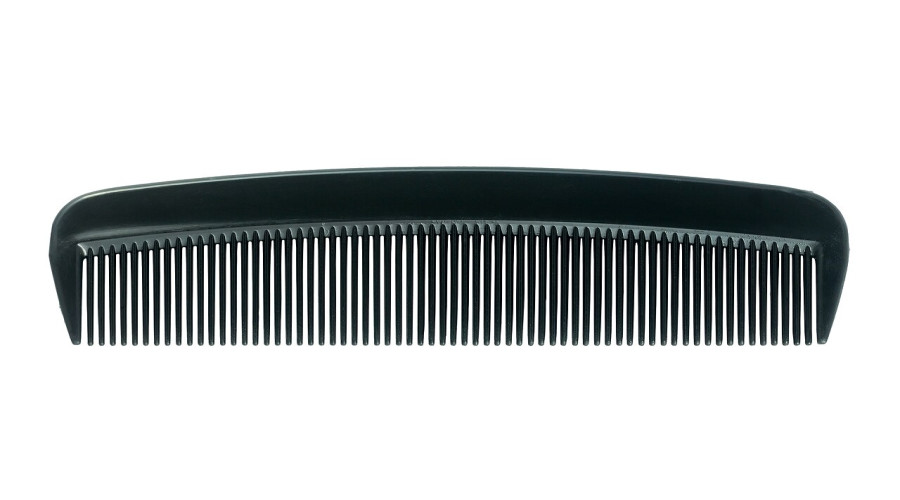
Image: Illustrative photo: a plastic comb. Photo: Crisco 1492 via Wikimedia Commons, CC BY-SA 4.0 (https://creativecommons.org/licenses/by-sa/4.0). Source: https://commons.wikimedia.org/wiki/File:Plastic_comb,_2015-06-07.jpg