UN Secretary-General António Guterres on Monday (23 November) called on countries to agree within the next year on a global framework for managing the risks of artificial intelligence (AI), backed by independent oversight.
He made the appeal at the Bridgetown Special Summit on AI Safety in Barbados, which the United Nations co-hosted with the Barbadian government. "Today I call for member states to coordinate efforts and to develop within the next year a globally inclusive and principles-based multilateral framework for AI risk management, backed by independent and credible oversight," Guterres said, as quoted by Al Jazeera.
Speaking to reporters at the close of the summit, Guterres said protections against AI risks remain fragmented and that governments are too often "playing catch-up", according to UN News. "Put simply, we need a common foundation for AI safety," he said. He suggested that countries could start by agreeing on shared safety measures, a testing regime and basic requirements for independent oversight.
Guterres warned that AI is driving "the biggest transfer of power in the history of humankind", with power moving from states and institutions "to a small number of companies and persons". He said the institutions created after the Second World War, including the UN, are not adequately equipped for this shift. He also repeated his support for a ban on autonomous weapons, saying the idea of a machine choosing whom to kill was "absolutely unacceptable".
Inequality between countries was another theme. Guterres said the ability to manage AI risks "remains deeply unequal". To help close the gap, he has proposed a Global Fund for AI Capacity-Building, so that more countries can test whether AI systems work safely in their own conditions. UN News reported that 111 of the countries taking part in the first Global Dialogue on AI Governance in July had never before joined any discussion on AI.
Barbados Prime Minister Mia Mottley said small states "often do not have the opportunity to share perspective in the rules that affect them". She said governments buying AI systems should be able to switch off access in an emergency.
Guterres, whose term ends in December, said he would advise his successor that properly controlling AI would be essential for "humanity to maintain control of our world". Al Jazeera noted that international regulation still appears distant, as the United States and China compete for an edge in AI development.
Source: UN News, Al Jazeera
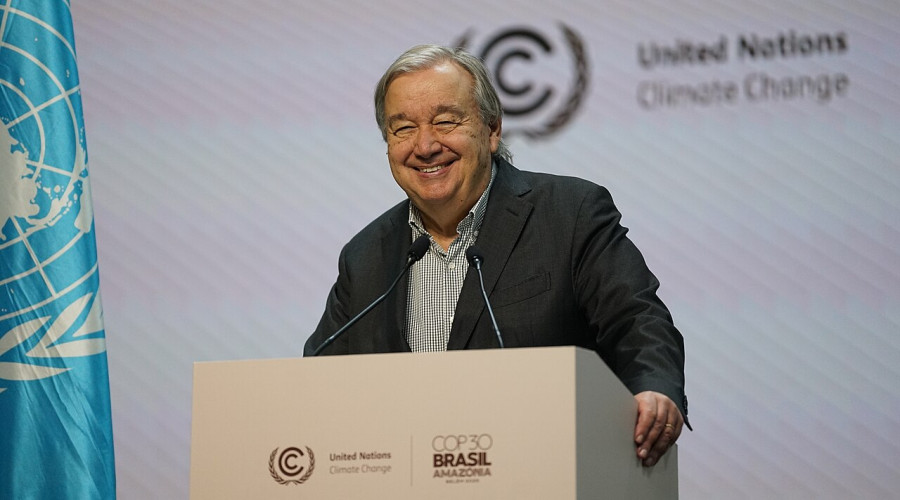
Image: File photo: UN Secretary-General António Guterres at COP30 in Belém, Brazil, in November 2025 (not from the Barbados summit). Photo: Xuthoria via Wikimedia Commons, CC BY-SA 4.0 (https://creativecommons.org/licenses/by-sa/4.0). Source: https://commons.wikimedia.org/wiki/File:COP30_-_Ant%C3%B3nio_Guterres_01.jpg