Farmers in the coastal district of Satkhira are assessing heavy losses after several days of rain brought by Cyclone Akvan left crops on 5,567 hectares of land under water, according to preliminary figures from the Department of Agricultural Extension (DAE).
The DAE estimate, reported on Sunday and Monday (22–23 November) by Dhaka Tribune, the state news agency BSS and The Business Standard, includes 2,271 hectares of Aman paddy, 2,729 hectares of mustard and 521 hectares of vegetables. Smaller areas of potato, khesari, chilli, onion and garlic were also affected.
The cyclone itself did not strike the Satkhira coast directly. Md Jamal Uddin, a DAE official at the Khamarbari office in Satkhira, said its influence nevertheless caused days of continuous rain, and that a list of losses had been sent to higher authorities. A local meteorological official told Dhaka Tribune that the district received 90mm of rain between Thursday morning and Saturday night, and that the weather returned to normal on Sunday.
The rain came at a difficult moment in the farming calendar. Many farmers had already cut their Aman paddy and left it in the fields to dry, and much of it ended up soaked. Farmers said the straw, which many use as cattle feed, had been ruined. Elsewhere, ripe paddy was still standing in waterlogged fields. With Aman selling at around Tk 1,040 per maund, farmers told BSS and The Business Standard that they had expected only thin profits even before the rain.
Mustard growers face a separate risk. Satkhira Sadar Upazila Agriculture Officer Plabani Sarkar told Dhaka Tribune that seedlings sown 15 to 20 days ago could be damaged if water stays in the fields for 36 hours or more. Abdul Wahab, a farmer from Brahmarajpur, said his mustard on four bighas of land had gone under water. Winter vegetable growers in Tala and other upazilas reported water standing in fields of cauliflower, cabbage, radish, tomato and eggplant.
In Ashashuni upazila, Aman paddy was grown on 9,250 hectares, and around 45 percent had been harvested before the rain, the upazila agriculture officer said.
Officials stressed that the figures are preliminary. DAE Deputy Director Iqbal Ahmed said teams were still working out how many farmers were affected and how large the financial losses were. Field officers are advising farmers to move harvested paddy out of the water and dry it under shelter, to cut channels to drain mustard fields quickly, and to consider a fungicide spray once the water recedes.
Source: Dhaka Tribune, BSS, The Business Standard
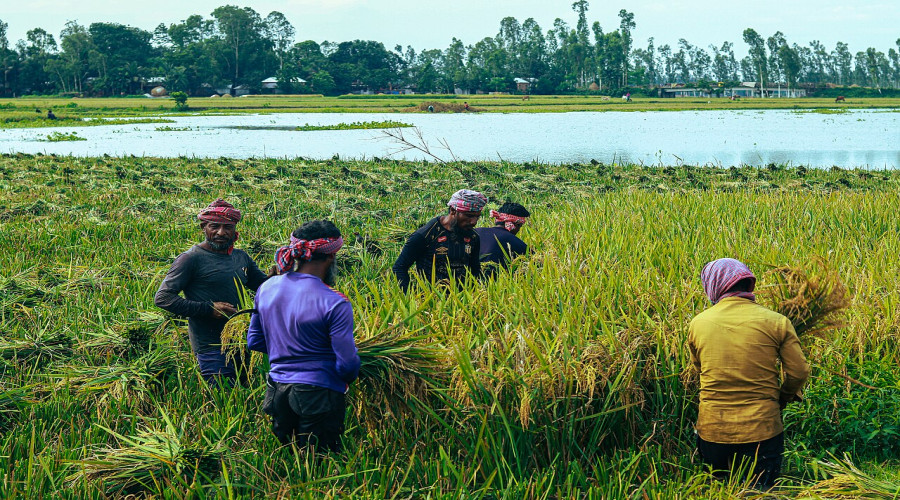
Image: Illustrative photo: farmers harvesting rice in a wetland field in Bangladesh (not from Satkhira or this month's rain). Photo: A S M Jobaer via Wikimedia Commons, CC BY-SA 4.0 (https://creativecommons.org/licenses/by-sa/4.0). Source: https://commons.wikimedia.org/wiki/File:Rice_harvesting_by_farmers_in_a_wetland_field,_Bangladesh_2026_01.jpg