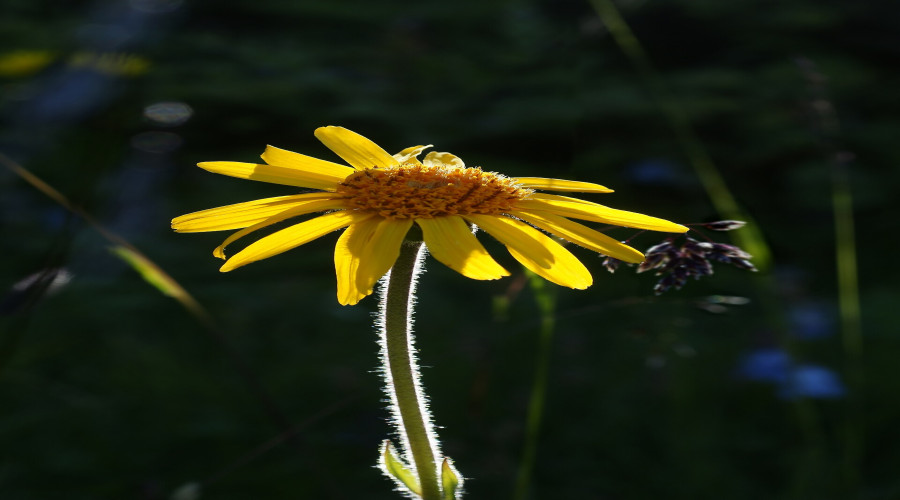
Arnica montana, also called mountain arnica or leopard's bane, is a yellow-flowered plant in the daisy family that grows in mountain regions of Europe. In homeopathy it is one of the best-known remedies prepared from a plant. Homeopathic products, the US National Center for Complementary and Integrative Health (NCCIH) explains, are typically made by repeated dilution of a starting substance, often with vigorous shaking, and may be sold as sugar pellets, tablets, drops, ointments, gels or creams. Many of the more dilute preparations contain little or no measurable amount of the original material. William Boericke's Pocket Manual of Homoeopathic Materia Medica (1901) lists the usual dose of Arnica as the third to the thirtieth potency. Boericke also mentions local use of the tincture, but states that it "should never be applied hot or at all when abrasions or cuts are present."
Undiluted arnica is not the same as a highly diluted homeopathic pellet. Crude arnica can irritate the skin and should not be swallowed; broken skin is a reason to avoid applying a tincture, as Boericke already warned. NCCIH also notes that some products labelled homeopathic may contain substantial amounts of active ingredients and could cause side effects or drug interactions.
In classical materia medica, Arnica is traditionally used in homeopathy for complaints that follow injuries, falls, blows, contusions and strains, and for a sore, lame, bruised feeling, as if the body had been beaten. Boericke writes that the remedy "produces conditions upon the system quite similar to those resulting from injuries, falls, blows, contusions," and that it is "especially suited to cases when any injury, however remote, seems to have caused the present trouble." He also describes soreness after overexertion, joints that feel sprained, black and blue spots, and a sensation that the bed "feels too hard." These are historical listings from homeopathic literature. They are not proof that the remedy works, and they are not a substitute for examination of a sprain, a deep bruise or a head injury.
A balanced reading of the scientific reviews is more cautious. In 2015 Australia's National Health and Medical Research Council concluded that "there are no health conditions for which there is reliable evidence that homeopathy is effective," after assessing 57 systematic reviews containing 176 studies. It said homeopathy should not be used to treat conditions that are chronic, serious, or could become serious, and that people who delay proven treatment may put their health at risk. NCCIH similarly states that there is little evidence to support homeopathy as an effective treatment for any specific health condition. An NHS England evidence review in 2017, prepared by the Specialist Pharmacy Service, likewise found the available evidence "not compelling" and noted that NICE does not recommend homeopathy for any clinical condition. Anyone with a serious injury should seek conventional medical care first.
This article is for general information only. Consult a registered physician before taking any medicine.
Sources: Boericke, Pocket Manual of Homoeopathic Materia Medica (1901); NCCIH, Homeopathy: What You Need To Know; NHMRC Statement on Homeopathy (March 2015); NHS England / Specialist Pharmacy Service, Clinical evidence for homeopathy (2017).
Image: Hans Hillewaert / Wikimedia Commons (CC BY-SA 3.0). Flower of Arnica montana.