The European Space Agency and the Japan Aerospace Exploration Agency's BepiColombo mission was scheduled to enter orbit around Mercury on 21 November, after an eight-year journey of almost six billion miles (about 10 billion kilometres).
Space.com, citing the mission plan, said a 37-minute orbit-insertion burn was due to begin at 18:24 GMT on 21 November. ESA's official arrival updates page had earlier stated that the composite spacecraft would enter orbit around Mercury on that date. This report describes the planned arrival and does not confirm that the burn has been completed.
BepiColombo launched aboard an Ariane 5 rocket from French Guiana in October 2018. It consists of ESA's Mercury Planetary Orbiter (MPO) and JAXA's Mercury Magnetospheric Orbiter, also known as Mio. The Mercury Transfer Module, which provided propulsion for most of the cruise, separated from the stack on 3 September 2026, ESA said. The two science orbiters remain attached and are due to separate on 9–10 December 2026.
Mercury is difficult to reach because it lies so close to the Sun. Spacecraft approaching the innermost planet are accelerated by the Sun's gravity and must shed a great deal of speed to be captured by Mercury's weaker pull. The mission therefore followed a long path — one flyby of Earth, two of Venus and six of Mercury — originally planned to take about seven years. That flight was extended by a year after a technical problem reduced the power available for the transfer module's electric thrusters, Space.com reported. The BBC, in a preview published a day earlier, likewise said a problem with the propulsion system had added a year to the voyage.
Only two spacecraft have visited Mercury before, both from NASA: Mariner 10, which flew past in the 1970s, and Messenger, which orbited the planet from 2011 to 2015. BepiColombo is intended to be the first mission to orbit Mercury with two spacecraft at once. Science operations are set to begin in April 2027. ESA has said the mission will study Mercury's magnetosphere and its interaction with the solar wind, the planet's large iron core and the origin of its magnetic field.
Professor Emma Bunce of Leicester University, a principal investigator on the mission, told the BBC: "I think it's a little bit of an under-loved planet in the inner Solar System, but I think that's one of the reasons why it is so compelling."
Source: European Space Agency, Space.com, BBC News
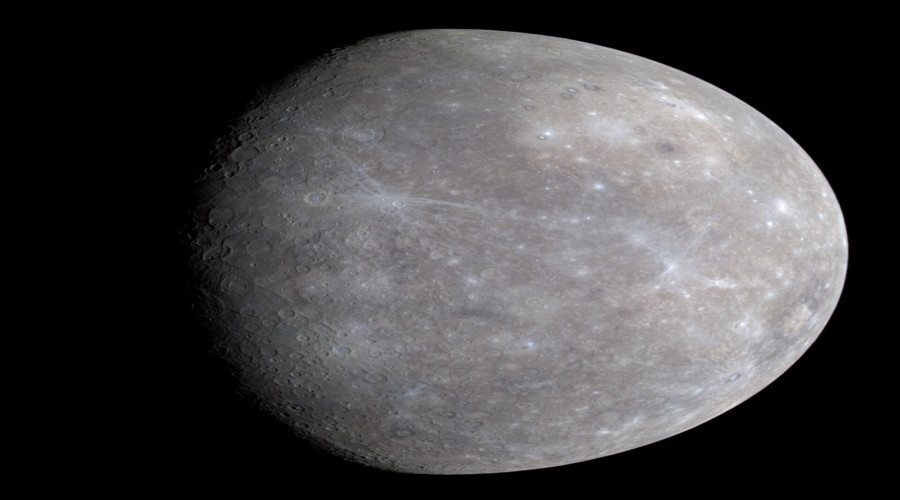
Image: NASA / Johns Hopkins University Applied Physics Laboratory / Carnegie Institution of Washington / Wikimedia Commons (public domain). Mercury in colour.