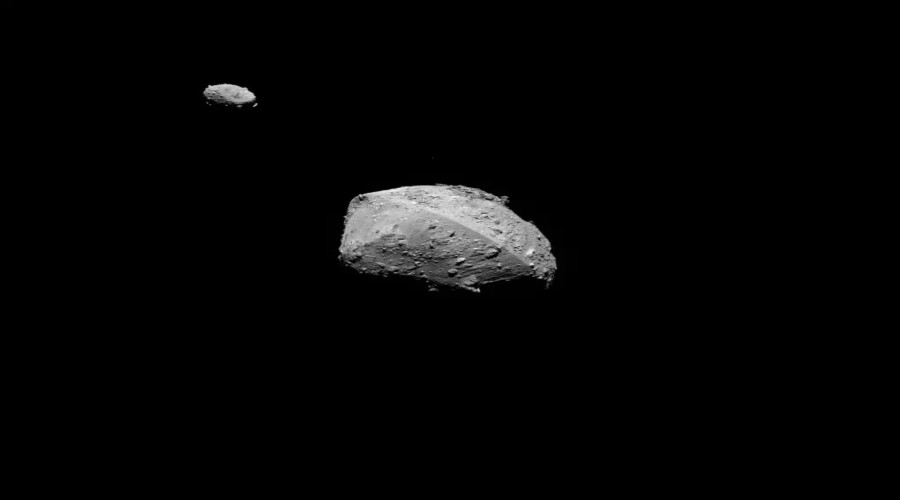
The European Space Agency's Hera spacecraft has sent back the first close-up images of the small asteroid Dimorphos since NASA deliberately crashed a probe into it in 2022, revealing a crater the size of a sports stadium, ESA announced on Wednesday (25 November).
In September 2022, NASA's DART spacecraft hit the 151-metre-wide Dimorphos at about 22,000 km/h to test whether an asteroid could be pushed off course. Dimorphos, which posed no threat to Earth, orbits a larger asteroid, the 730-metre Didymos. The impact shortened its orbit by about 33 minutes, much more than expected, ESA said. Telescopes measured that change, but no one knew what the collision had done to the asteroid itself.
"Scientists debated whether Dimorphos had sustained an impact crater, changed its shape or stayed the same," said Hera principal investigator Patrick Michel. "Much to our surprise the answer turns out to be all three at once!" He said the face struck by DART had been flattened into a crater that stretches across the asteroid's entire width. The rest of Dimorphos looks much as it did in DART's images.
The impact also changed the way the asteroid moves. Before the collision, Dimorphos always showed the same face to Didymos, as the Moon does to Earth. "Now it's very, very chaotic - it's tumbling," Hera science team member Dr Sabina Raducan told the BBC.
Hera's images revealed another surprise: hundreds of previously unknown boulders, just a few metres across, orbiting the pair of asteroids. ESA mission scientist Michael Kueppers said the team will have to take them into account as the spacecraft moves closer for higher-resolution pictures.
The car-sized spacecraft will study the two asteroids over the next six months. A key goal is to measure the mass of Dimorphos, which will show how effective DART's push really was. Scientists say that information would be vital if a space rock were ever found on a collision course with Earth. Hera also carries two shoebox-sized satellites that will study the impact site close up and later land on the asteroid.
ESA said the mission combines NASA's demonstration that an asteroid can be deflected with a detailed investigation of what happened, with contributions from partners including Japan's space agency JAXA. ESA Director-General Josef Aschbacher called it "international collaboration at its best".
Source: European Space Agency (ESA), BBC
Image: The crater left on asteroid Dimorphos by NASA's DART impact, as seen by Hera's Asteroid Framing Camera. Image: ESA (official ESA press image). Source: https://www.esa.int/articles/about-us/directorates/operations/space-safety/hera/hera-reveals-stadium-sized-asteroid-crater-left-after-spacecraft-impact